
PRP Hair Treatmentin Gangnam, Seoul
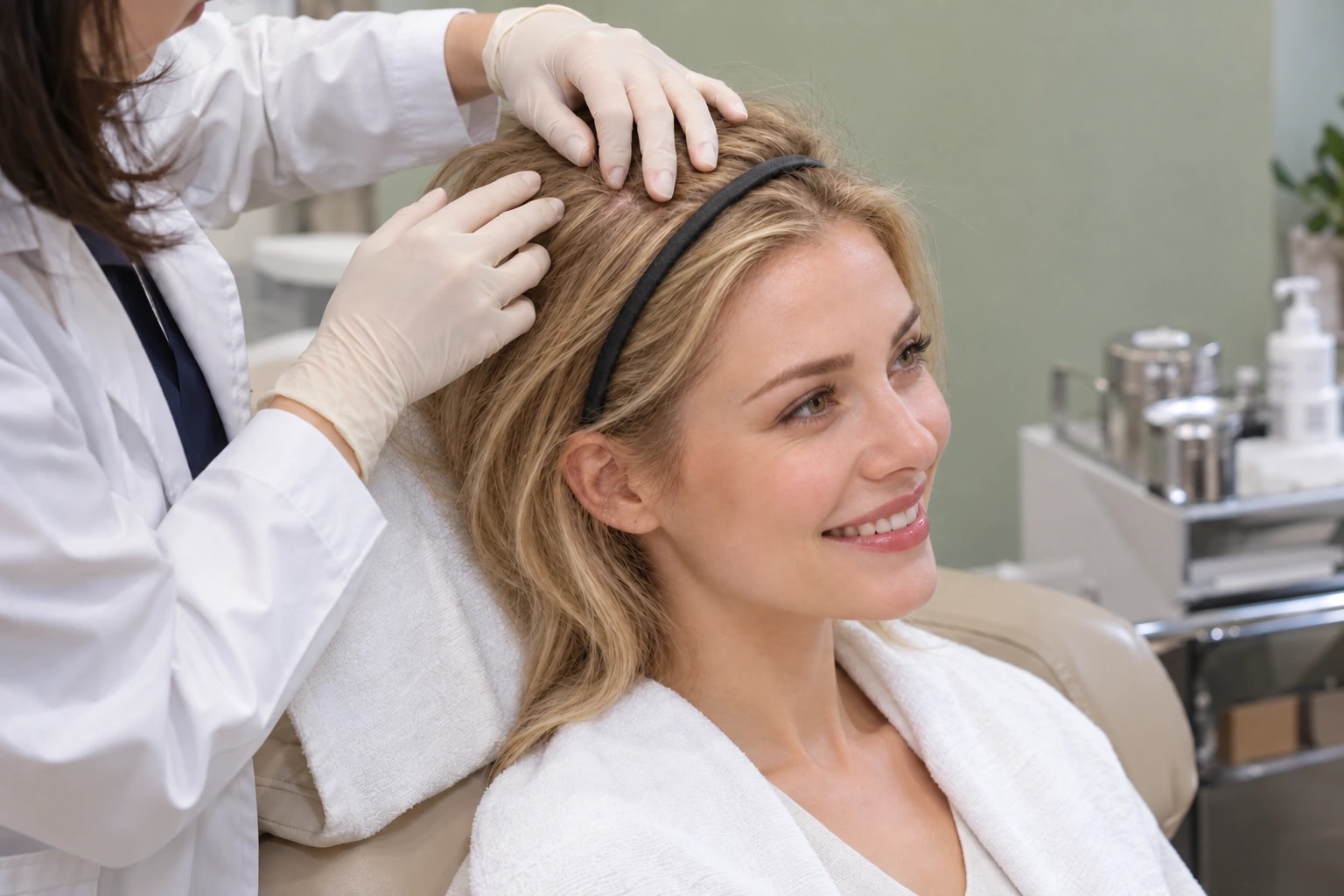
PRP (platelet-rich plasma) uses a small sample of your own blood, concentrated to isolate platelets and their growth factors, then injected into the scalp to support the hair follicles. At QD Clinic in Gangnam, Seoul, South Korea, we assess your scalp and hair pattern first, then plan the treatment areas and number of sessions. A session usually takes about 30 minutes. (Results vary by individual.)
Who it’s for
- Early thinning or reduced density along the hairline or crown
- People who prefer using material derived from their own blood
- Those looking to support other hair-loss care such as medication
PRP is not suitable for everyone; suitability is confirmed after a scalp assessment at consultation.
How it works
A small amount of blood is drawn and spun in a centrifuge to concentrate the platelets. Platelets release growth factors — such as PDGF, VEGF and IGF — that are involved in follicle signaling, local blood supply and the hair growth cycle. The concentrated plasma is injected into the scalp at the level of the follicles. PRP is often used alongside medication or other in-clinic treatments as part of a plan.
THE MECHANISM, STEP BY STEP
01Concentrated from your own blood
A small blood sample is spun in a centrifuge to separate and concentrate the platelets, so the material injected comes from your own body.
02Growth factors do the signaling
Concentrated platelets release growth factors such as PDGF, VEGF and IGF, which are involved in follicle signaling, local blood supply and the hair growth cycle.
03Placed at follicle depth
The plasma is injected into the scalp at the level of the follicles across the areas planned at consultation, rather than applied only to the surface.
04Support over a course
PRP is intended to support the environment around existing follicles gradually, which is why it is usually done as a course and often alongside medication.
Treatment areas
- Frontal hairline
- For thinning along the front hairline.
- Crown / vertex
- For reduced density at the crown.
- Diffuse thinning
- For overall thinning across the top of the scalp.
What the procedure is like
- 1Scalp and hair assessment
- 2Blood draw from the arm
- 3Centrifugation to concentrate the platelets
- 4Injection into the planned scalp areas
- 5Soothing and aftercare guidance
Time: A session takes about 30 minutes, including preparation.
Recovery & aftercare
- Little downtime; most people return to daily activities the same day. A topical numbing cream may be used for comfort.
- Temporary redness, mild tenderness or pinpoint swelling at the injection sites may occur.
- Follow the scalp aftercare — such as when to wash your hair — that we provide.
What to expect over time
A general guide to how the days and months after treatment usually unfold. Results vary by individual.
DAY 0 Session day
Blood draw, preparation and scalp injections; brief redness or tenderness may follow. Most people return to daily activities the same day.
DAY 1-3 Settling
Any redness, tenderness or pinpoint swelling at the injection sites generally eases.
WEEK 3-6 Repeat sessions
PRP is usually done as a course, with sessions spaced a few weeks apart as planned at consultation.
MONTH 3-4 Gradual change
Some people notice reduced shedding or better-supported density as the course continues, appearing gradually rather than immediately. (Results vary by individual.)
ONGOING Maintenance
A maintenance interval is decided at consultation, often combined with medication and regular follow-up.
Sessions & results
Hair-loss treatment is usually done as a course — for example several sessions spaced a few weeks apart — with a maintenance interval decided at consultation. Changes appear gradually over months. (Results vary by individual.)
How it compares
PRP Hair Treatment, Exosome Scalp Treatment and topical medication all aim to support thinning hair, but they differ in what is used and how it is delivered, so they suit different situations.
| Comparison | PRP Hair Treatment | Exosome Scalp Treatment | Topical medication |
|---|---|---|---|
| Approach | Injected concentrate from your own blood | Applied exosome product, usually with microneedling | Applied at home to the scalp |
| Material | Autologous platelets and growth factors | Prepared exosome vesicles | Minoxidil or other agents |
| Typical use | A course of in-clinic sessions | A course of in-clinic sessions | Daily, ongoing |
| Downtime | Little to none | Little to none | None (may cause dryness) |
Neither is “better” — they work differently and suit different goals. The right choice is decided after we assess your skin.
Safety & considerations
Possible reactions
- Temporary redness, tenderness or a tight feeling of the scalp
- Pinpoint swelling or small bruising at the injection sites
- A short-lived headache or soreness after the session
When to take extra care
- Bleeding or clotting disorders, or use of blood-thinning medication — tell your doctor
- Active scalp infection, inflammation or open lesions in the treatment area
- Pregnancy or breastfeeding — let us know at consultation
- Certain blood conditions that may make PRP unsuitable
- Recent scalp procedures or treatments — tell your doctor so timing can be planned
PRP is not suitable for everyone and is usually part of a wider plan rather than a stand-alone cure. Whether it suits your scalp is confirmed at consultation. Effects vary by individual, and side effects may occur.
Your care at QD Clinic
Performed by a board-certified doctor
Your treatment is performed and medically reviewed by a board-certified doctor, not delegated unsupervised.
Prepared from your own blood
The material is concentrated on site from a small sample of your own blood, discussed with you before treatment.
Care in your language
Consultation in English, with 中文 and 日本語 support arranged on request — including questions before you travel.
A short walk from Gangnam Station
Central Seoul location with guidance from the airport and nearby hotels, and hours shown in KST.
Frequently asked questions
A topical numbing cream can be used, and most people feel only brief discomfort as the scalp is injected. The blood is drawn from the arm before the injections. A session takes about 30 minutes including preparation, and most people return to daily activities the same day.
One or two sessions are not enough to judge; we assess after several sessions spaced apart. Hair grows in cycles, so it takes a few months before a change can be confirmed. At the start we photograph your scalp and later take the same shot from the same position, so the comparison holds up.
This is not a treatment that changes things immediately; the change appears gradually over several months. Because the hair growth cycle itself is long, it matters more to complete the planned sessions steadily than to judge after just a few. How much changes differs from person to person with the type of hair loss and the condition of the scalp.
You can usually go about your day after the session. Redness, mild tenderness or pinpoint swelling at the injection sites may appear for a while. We tell you when you can wash your hair and how to look after your scalp in the meantime.
Yes. PRP is often used alongside topical or oral medication and other in-clinic treatments as part of a wider plan. It is not usually a stand-alone cure, so continuing the treatment you have been prescribed matters. How the pieces fit together is decided at consultation.
Not always. Certain blood or scalp conditions may make it unsuitable, so we assess your scalp and hair pattern first. Because it uses your own blood, tell us beforehand about any blood-related condition and the medicines you take.
We draw your own blood, spin it in a centrifuge to collect the platelet-rich fraction, and inject that into your scalp. What sets it apart is that it is not an outside drug, but material obtained from your own blood. The blood draw and the injections are done in the same visit, and it usually does not take long.
We first check whether assessment and any necessary follow-up fit your stay. Share your arrival, departure and important event dates before booking. For this treatment, the expected course is as follows. Hair-loss treatment is usually done as a course — for example several sessions spaced a few weeks apart — with a maintenance interval decided at consultation. Changes appear gradually over months. (Results vary by individual.) Temporary redness, mild tenderness or pinpoint swelling at the injection sites may occur. Follow the scalp aftercare — such as when to wash your hair — that we provide. Examination may lead to postponement or additional visits. Confirm contact arrangements after returning home and when in-person medical care may be needed. What the doctor checks first for this treatment: “What the blood-derived platelet concentrate contains and the evidence for it by type of hair loss”.
Often considered together
Treatments that are sometimes planned alongside this one, decided at consultation.
+Hair-loss medication
Topical or oral medication may be used alongside PRP as part of a plan, discussed and prescribed where appropriate at consultation.
+Exosome Scalp Treatment
Another in-clinic option that supports the follicle environment, applied to the scalp rather than drawn from your blood; whether to combine or alternate is decided by your doctor.
+Scalp booster treatments
Microneedling-based scalp care may be considered to complement injections, depending on your scalp condition.
For international patients
Consultation in English / 中文 / 日本語 · WhatsApp · WeChat · KakaoTalk · a 4-minute walk from Sinnonhyeon / Nonhyeon Station (hours in KST).
How many days should I stay?
Surgery and course-based treatments need a check-up. We tell you before you book whether that means staying longer or coming back another time.
For International Patients